Manet S Olympia Is a Reference to What in Previous Art?
It has been described as one of the "about controversial" paintings from the 19th century, yous know that famous painting of a woman lying down and gazing direct at us as if she knows we are watching her. This is of course Manet's Olympia (1863), or shall nosotros say the nearly infamous painting from the 1800s? In this commodity, we will provide a Manet Olympia analysis and discuss the question, only what was the artist of Olympia trying to exercise?
Table of Contents
- 1 Artist Abstruse: Who Was Édouard Manet?
- 2 Olympia past Édouard Manet In Context
- ii.1 Contextual Analysis: A Brief Socio-Historical Overview
- 3 Formal Analysis: A Brief Compositional Overview
- 3.1 Discipline Matter
- 3.2 Colour and Light
- 3.three Loose Brushstrokes
- 3.iv Perspective and Line
- 3.5 Scale and Scandal
- three.6 Manet's Olympia: Symbolic References
- 4 Manet and Feminism: Olympia, the Maid, and the Matter of a Gaze
- 5 Manet: Causing a Scene
- six Frequently Asked Questions
- half dozen.one What Is That Famous Painting of a Adult female Lying Down?
- 6.2 What Was the Artist of Olympia Trying to Do?
- vi.iii Who Was Manet's Olympia?
Creative person Abstract: Who Was Édouard Manet?
Édouard Manet was a French creative person, born on 23 January 1832. He was born in Paris into a wealthy family. He was always interested in art and subsequently enrolling in the Navy and Marines at his father's behest he pursued his studies in fine art. From 1850 up to 1856 he started studying under Thomas Couture, who was a French teacher and creative person. After his studies, he started his ain fine art studio, which was in 1856. Manet was a revolutionary artist of his time, going against the traditional grain of the Salon. He was also acquainted with numerous artists and scholars, notably Gustave Courbet and Charles Baudelaire.
Manet is remembered equally ane of the leading artists of Impressionism, however, he was too a role of the Realism art movement and depicted scenes of modern life.
 Close-upward photo of artist Édouard Manet, before 1870;Nadar, Public domain, via Wikimedia Commons
Olympia by Édouard Manet In Context
Manet'due south Olympia has been the bailiwick of numerous outrages and shocked viewers. For its fourth dimension, during the 1800s, information technology was a painting that acquired controversy considering what Manet depicted was not a mythological, and therefore accepted, nude female person effigy, just the nude female figure of a prostitute with various suggestive objects alluding to this.
In this article, we volition provide a Manet Olympia analysis starting with a contextual analysis, which will talk over Manet and his artworks in more detail to provide context for why he painted Olympia. Furthermore, we volition discuss the significance of the dominant art motility Manet was involved in during his fine art career, which was Realism so Impressionism.
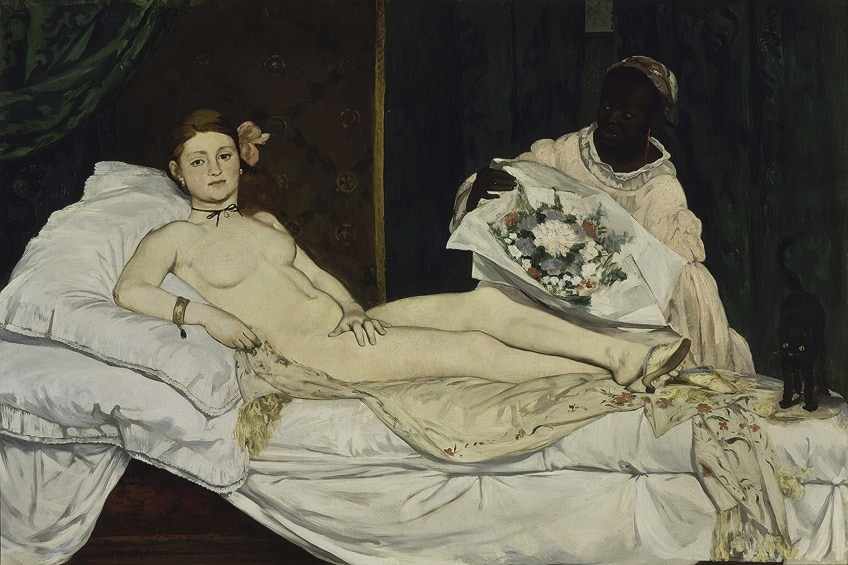 Olympia (1863) by Édouard Manet;Édouard Manet, Public domain, via Wikimedia Eatables
We will then provide a formal analysis by taking a peek at Olympia and Manet's overall subject matter and stylistic elements, for instance, the color, brushwork, perspective, and calibration.
| Artist | Édouard Manet |
| Date Painted | 1863 |
| Medium | Oil on sail |
| Genre | Genre painting |
| Period / Move | Realism, Impressionism |
| Dimensions | 130.5 x 190 centimeters |
| Series / Versions | Not applicative |
| Where Is It Housed? | Musée d'Orsay, Paris |
| What Information technology Is Worth | Not available |
Contextual Analysis: A Brief Socio-Historical Overview
When Manet painted Olympia in 1863 the artistic climate in Paris, but Europe more often than not, functioned under traditional rules about how art should look and exist. The Salon was a famous annual (sometimes biannual) exhibition, which started in 1667. It was the master exhibition for the Imperial Academy of Painting and Sculpture, or in French, Académie Royale de Peinture et de Sculpture, which was started in 1648 by Charles le Brun.
 An ordinary associates of the Royal University of Painting and Sculpture at the Louvre (1712-1721) past Jean-Baptiste Martin; Jean-Baptiste Martin, Public domain, via Wikimedia Commons
Somewhen, the Academy ended during the time of the French Revolution in 1793 and it was restarted as the University of Painting and Sculpture. It was combined with two other art schools in 1816, namely the Academy of Music and the Academy of Compages. This became known as The French Academy of Fine Arts; in French, it is the Académie des Beaux-Arts.
The Salon exhibition was named after the Salon Carré, which is a room in the Louvre in Paris. It was the main location for many exhibitions, initially merely for the students from the École des Beaux-Arts (School of Fine Arts) or the members of the Royal University of Painting and Sculpture to showcase their artworks.
Information technology was a conservative exhibition space and event, although it was one of the grandest exhibitions held and was a reputable opportunity for anyone who exhibited.
However, from 1725 the Salon started exhibitions in the Louvre, mentioned above, and its name changed to Salon de Paris. Although it was more public, allowing more artists to exhibit, a jury judged the artworks from 1748. The jury was a selection of artists who were too ordinarily selected from the Academy itself and had the know-how, so to say, about judging the artworks according to the standards of the time.
The Salon was a prestigious upshot and attracted scholars, fine art dealers, collectors, and art patrons. It was also the only large exhibition in French republic, and information technology held a level of power and control over the professional careers of artists. It followed conservative rules based on academic principles and the artistic standards, or "canons", from Classical Artifact.
 Salon of the National Society of Fine Arts in 1890 ; Jean-André Rixens (1846-1925), Public domain, via Wikimedia Commons
It is important to note that during this time, art was judged according to a hierarchy of painting genres. Each genre ranked from the most "moral" discipline affair to the lowest. This was about how a morally based message or story would exist conveyed through the subject matter as well equally how accurately the human body would be painted.
History painting was the offset genre on the list. This was a genre where Biblical and mythological subject thing would depict moral letters in the all-time fashion, and it allowed artists to paint the human being form, and this is where their creative skill too showed. The next genre was Portraiture and and then Genre Paintings, which depicted everyday scenes and were also smaller in size. The other, less prestigious genres included Landscapes and All the same Life Painting.
Painting as a medium was besides more meaning than the medium of sculpture.
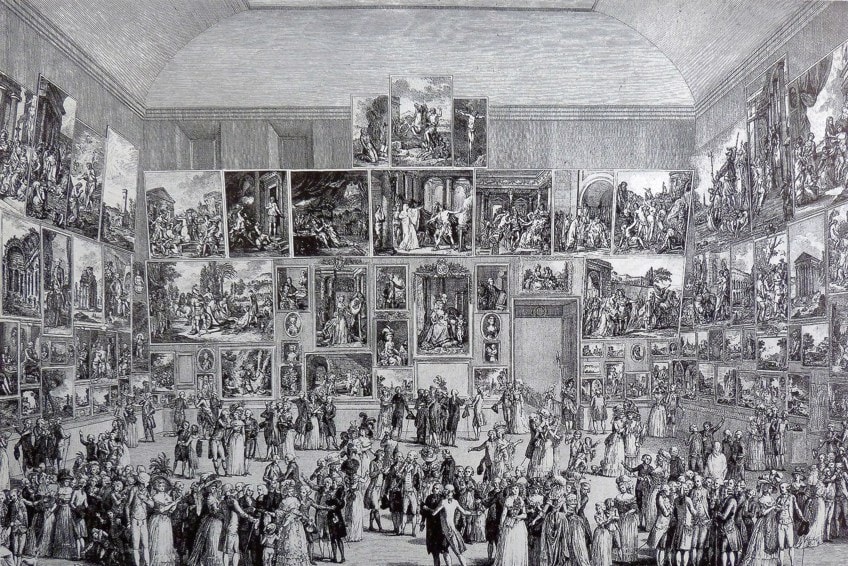 Salon exhibition at the Louvre in 1787;Pietro Antonio Martini (1738–1797), Public domain, via Wikimedia Commons
Although the Salon's history is more than complex than what nosotros have outlined above, what is important to understand from this is that there was significant conservatism and rules practical to how art should be painted and conveyed to the public – in that location were standards to uphold.
Therefore, when we wait at Manet's "Olympia", which was exhibited in the Salon in 1865, we will empathize the social and cultural context it was placed in.
Undoubtedly, many were shocked that this Olympia painting was not painted according to standard conventions that dictated depictions of mythological or biblical figures. Furthermore, it was a depiction of an everyday adult female, more scandalously, a prostitute. It was non the accustomed depiction of a classical female nude similar a goddess for example. Importantly, the audition who saw this painting consisted mainly of men who were educated and in elitist circles, especially the Salon.
From Conservatism to Modernism
Edouard Manet's Olympia became a turning point painting from the 19th century. It broke the artistic rules and portrayed discipline matter and style in a new fashion. Up until that time, conservative classical conventions ruled art, simply a Modern era started, this was likewise during the onset of the Industrial Revolution during the eighteenth century.
During this fourth dimension at that place was a developing art movement called Realism, which centered effectually fine art depicting everyday life and not so much field of study matter (such as Biblical and mythological) that was far removed from what the modern-day person was experiencing.
Realism was pioneered by the French artist Gustave Courbet who wanted to paint what he experienced and saw in the world. He did not follow the academic rules of art. He influenced other artists to follow new conventions, which likewise set the foundations for the developing Impressionist art movement.
Manet followed in the footsteps of painting inside the Realist art manner forth with Gustave Courbet. Manet likewise inspired many new artists like Claude Monet, Pierre-Auguste Renoir, Camille Pissarro, Paul Cézanne, Alfred Sisley, and others, all of whom were part of the new Impressionism art movement.
 Le Désespéré (1841) by Gustave Courbet;Gustave Courbet, Public domain, via Wikimedia Commons
Manet'south unique avant-garde arroyo inspired these artists to follow their own style and non the traditional conventions of academic art. However, Manet reportedly maintained his goal of exhibiting with the Salon regardless of the rejection and ridicule he underwent from his controversial paintings.
Another important figure in the move to Modernism was Charles Baudelaire, who was besides a good friend of Manet's.
Baudelaire was a French writer, poet, and art critic. He wrote several important essays around the thought of Modernism during xixth century France, specially how it implicated artists and the development of their styles and expressions, during the artistic climate of Realism and Impressionism.
Some of Baudelaire'southward seminal essays include On the Heroism of Modern Life (1846) and The Painter of Modern Life (1863). Furthermore, Baudelaire and Manet used to come across at the Tuileries Gardens in Paris and spent considerable time together; Manet depicted Baudelaire in his Music in the Tuileries (1862) painting.
 Music in the Tuileries (1862) by Édouard Manet;Édouard Manet, Public domain, via Wikimedia Commons
What was of import about Baudelaire's theories was his statement that mod life was "heroic" and that it held merit just equally much as the subject matter explored from the Classical era. He placed value on the importance of the modern man and on the role of the painter who conveys the urban life that enlivens the Modern era through art. He also referred to the idea of the "flâneur", which means "stroller" or "loafer" in English language, and stated that artists need to be part of and detached from the city life. We volition also notice that Manet painted himself about the far left in his Music in the Tuileries. He has been described as embodying the idea of the "flâneur".
Baudelaire wrote that Modernity is "the transient, the fleeting, the contingent" and nosotros see the essence of this notion in how Manet painted.
With his loose brushwork, he seemingly captures this fast-paced lifestyle of the Modern world that was so deeply dissected and revered by many scholars, writers, and artists during the 19th century. Furthermore, if we expect at Manet's Olympia painting through the lens of the Modern man at play we volition have a deeper understanding of the question we posed to a higher place: what was the artist of Olympia trying to practise? Manet's expressive style of painting seemed to be inherently tied to the Modern lifestyle.
Formal Analysis: A Brief Compositional Overview
Manet'south Olympia could be considered the "poster daughter" of unabashedness. She is propped upward on her long chair, or as it is called in French chaise longue, staring comfortably at the viewers, which in her time would take mostly consisted of men – this could also be in the direction of an approaching client. Below, nosotros discuss this subject affair further also as look at Manet's option of creative elements.
Subject field Affair
Let united states of america start with the key figure, who, as the title suggests, is Olympia. We see her relaxed and reclining on a chaise longue bedecked in white sheets with a flossy-colored Oriental throw or shawl over information technology; Olympia reclines on top of the throw holding part of it casually in her correct paw (our left) as her elbow rests on the large pillow.
This gesture also hints at the thought that she does not need to embrace herself and she is comfortable with her nudity.
Her left hand (our correct) is placed over her genital surface area, her fingers resting on the top of her right upper thigh. Her legs are crossed, her left leg is over her correct leg, which creates more coverage almost her genital area and ironically draws more attention to it, specifically with the way her hand is resting. However, the way her hand is placed does not appear as if she is trying to cover herself, information technology appears as if she is just resting her paw in that surface area.
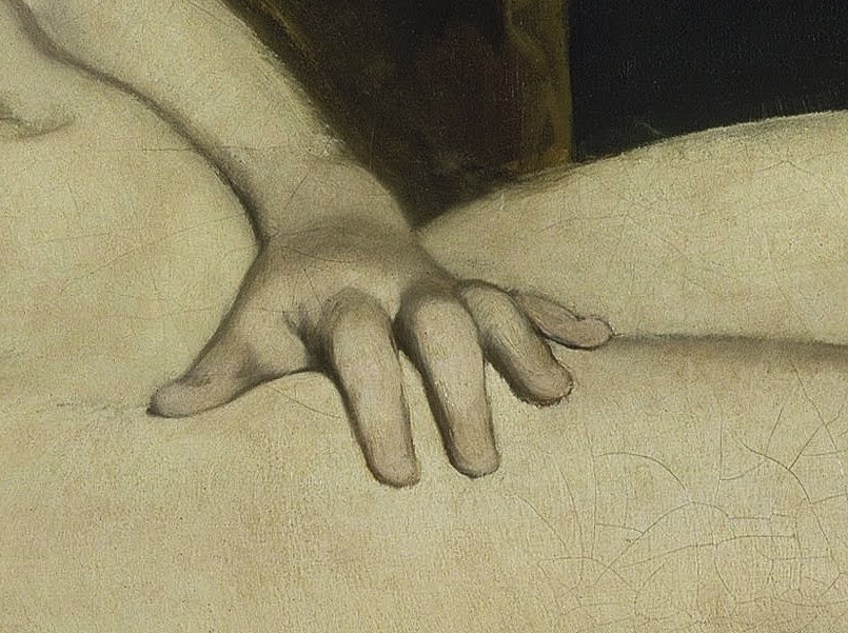 A detail from Olympia (1863) by Édouard Manet;Édouard Manet, Public domain, via Wikimedia Commons
Around her neck is a delicate blackness ribbon with what appears to be a transparent precious stone attached to information technology. She wears a aureate bracelet on her right wrist (our left) and what appears to exist pearl earrings in each ear; tucked behind her left ear is a large pinkish flower, possibly an orchid. She wears dainty heeled golden slippers with blueish trimmings, the slipper on her right foot has come up off leaving her foot exposed.
Olympia reclines completely in the nude and her off-white skin colour stands out from the darker environment, and almost blends in with the whites on her chaise longue with hints of gold from her jewelry and accessories as well every bit the throw she reclines on.
Her brunette pilus is tied back and almost blends in with the darker wall colors behind her. The wallpaper behind her is darker shades of green and mustard with diverse patterns. To the left, we see a night green satin curtain.
These darker shades of colors from the background emphasize the foreground, placing most of the attention on the lighter whites from Olympia and her bedding.
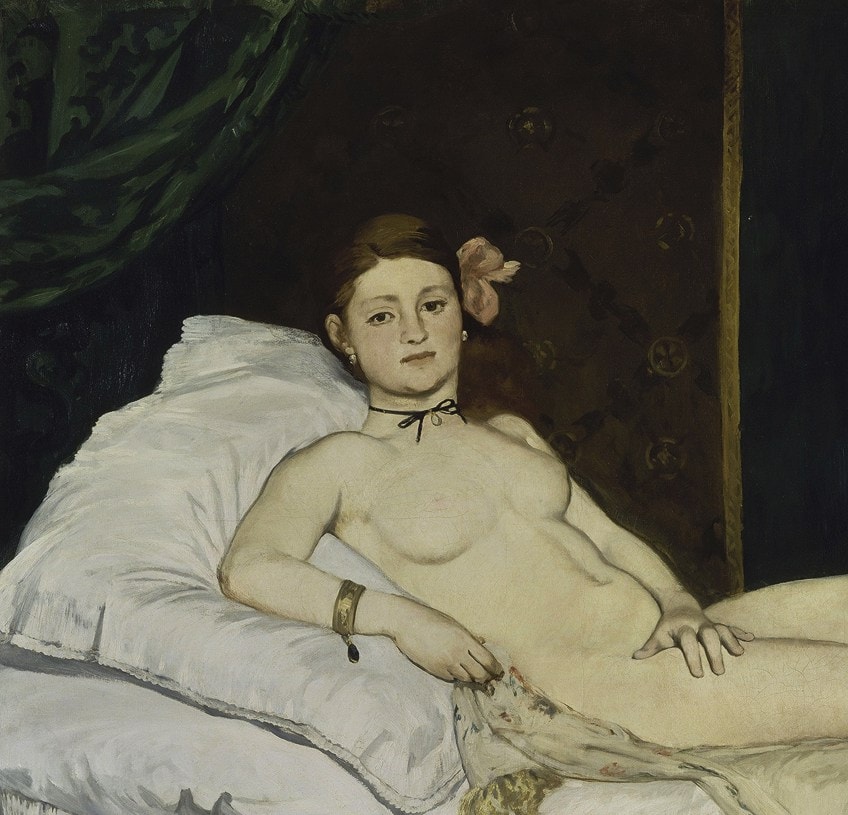
A close-up of Olympia (1863) by Édouard Manet;Édouard Manet, Public domain, via Wikimedia Commons
Continuing on the other side of the chaise longue, merely off-center towards the right side of the composition is a maidservant presenting Olympia with a bouquet of flowers in white wrapping paper. Similarly, the maid-servant wears fair-colored wear, which blends in with the foreground. Her darker skin complexion blends in with the darker background colors like Olympia's hair color.
On the end of the chaise longue, to the far right, is a black true cat standing on all fours and its tail up in the air. Could the cat be depicted as either getting up from sleeping or about to lie downward? The true cat looks in our direction, similarly, the famous Olympia also looks in our management, while the maidservant looks at Olympia seemingly trying to get her to look at the flowers.
Her correct hand (our left) appears as if it is opening the white wrapping paper to expose the flowers a little bit more.
Who Was Olympia?
The adult female reclining, who we have come to know equally Manet's Olympia, was Victorine-Louise Meurent, who was a French model and painter. She was a model for several of Manet's paintings, including the famous Le Déjeuner sur Fifty'Herbe (The Luncheon on the Grass) (1862 to 1863). Her paintings were too exhibited at the Salon in Paris, of which were accustomed on several occasions.
 Le Déjeuner sur fifty'herbe (Lunch on the Grass) (1863) by Édouard Manet;Édouard Manet, Public domain, via Wikimedia Commons
When we look across the woman who modeled as Olympia, the bodily term "Olympia" used equally the title of Manet'southward painting has a history of its ain. "Olympia" was used to refer to prostitutes during the 1800s in French republic, however, there has been scholarly debate about why Manet chose this term.
The article from Sharon Flescher, titled More than on a Proper noun: Manet'southward "Olympia" and the Defiant Heroine in Mid-Nineteenth-Century France (1985) suggests the term "Olympia" could have a likeness to the idea of a powerful heroic female. In Flescher'due south paper, she mentions the opera Herculaneum kickoff shown in Paris in March 1859.
The queen in the play was named "Olympia" and was a pagan queen sent to put a end to the progress of Christianity. In the play, she also uses her powers to seduce the Christian Helios away from his lover. She likewise stands unwaveringly while Mount Vesuvius erupts, and lava approaches her.
Furthermore, Flescher also mentions Manet'south teacher, Thomas Couture'southward painting The Romans in their Decadence (1847), and the opera Herculaneum existence a "theatrical counterpart" to it. The similarities between both Manet and Couture lie in the central reclining female figure. In Couture's painting the female reclines quite passively and, in the opera, "Queen Olympia" is a strong figure, "she herself is the source of power".
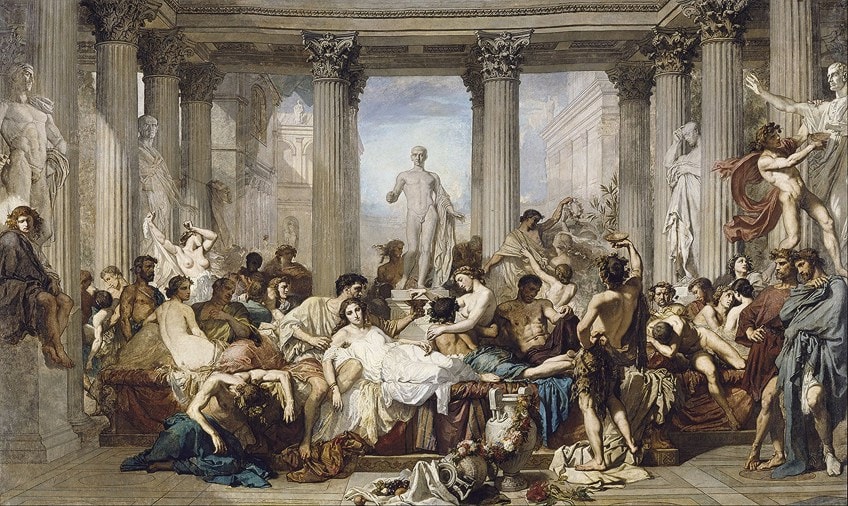 The Romans in their Decadence (1847) by Thomas Couture;Thomas Couture, Public domain, via Wikimedia Commons
What Flescher aimed to convey in her commodity was the way the championship "Olympia" was understood and perceived during Manet'south time and generally the 1800s France and that it may refer to a "female blazon". Could information technology be that Manet's Olympia was depicted as a stiff instance of a female figure although she was a courtesan?
Nosotros certainly see a level of confidence in her from her seemingly unwavering gaze and comfort with her nudity.
There are numerous suggestions and postulations near the title "Olympia" and why Manet could have used this title. Some sources also suggest that Manet's friend Zacharie Astruc may have given the championship to Manet'southward painting. When Olympia was exhibited at the Salone a function of Astruc's verse form was included for the painting's itemize entry.
Manet's Olympia was modeled on the Italian Renaissance Titian and his Venus of Urbino (1534) painting, admitting in his own expressive fashion, which would merit an commodity of its own. Nosotros see numerous differences in the manner both artists depicted their cardinal female figures; what stood out in Manet's Olympia was her lack of voluptuousness and thinness, a seeming misrepresentation of how female figures were supposed to exist painted, which was voluptuous and delicate as we in Titian's Venus.
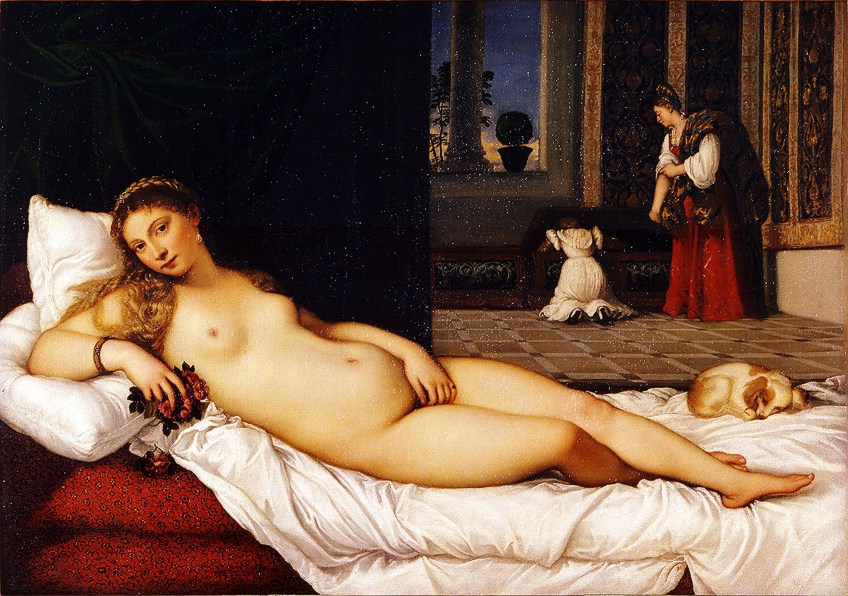 Venus of Urbino (1538) by Titian; Titian, Public domain, via Wikimedia Eatables
Color and Low-cal
If we look at the color and delineation of light in Manet'southward Olympia there is a stark difference to the academic paintings that preceded it. We run across a flatter composition because of the mode Manet situated the lighter and darker colors. Furthermore, the stark white skin tone of Olympia appears as if at that place is harsh lighting on her, possibly from a studio light?
Manet included large areas of color, specially the focus on white in the foreground and the background, which is completely darkened. This creates near no sense of depth in the limerick.
Loose Brushstrokes
Manet painted in loose brushstrokes and if we expect closely, nosotros will notice how his application of paint appears seemingly haphazard and rushed. This was a newer method of applying paint, especially compared to the academic rules of paint in an near perfect mode – this caused fifty-fifty more shock in the viewers when the painting was exhibited.
This loose brushwork is a direct reflection of Impressionism and inspired many of the Impressionist artists to follow in Manet's brushstrokes, so to say. Information technology was a testament to the delineation of modernistic life and everyday scenes.
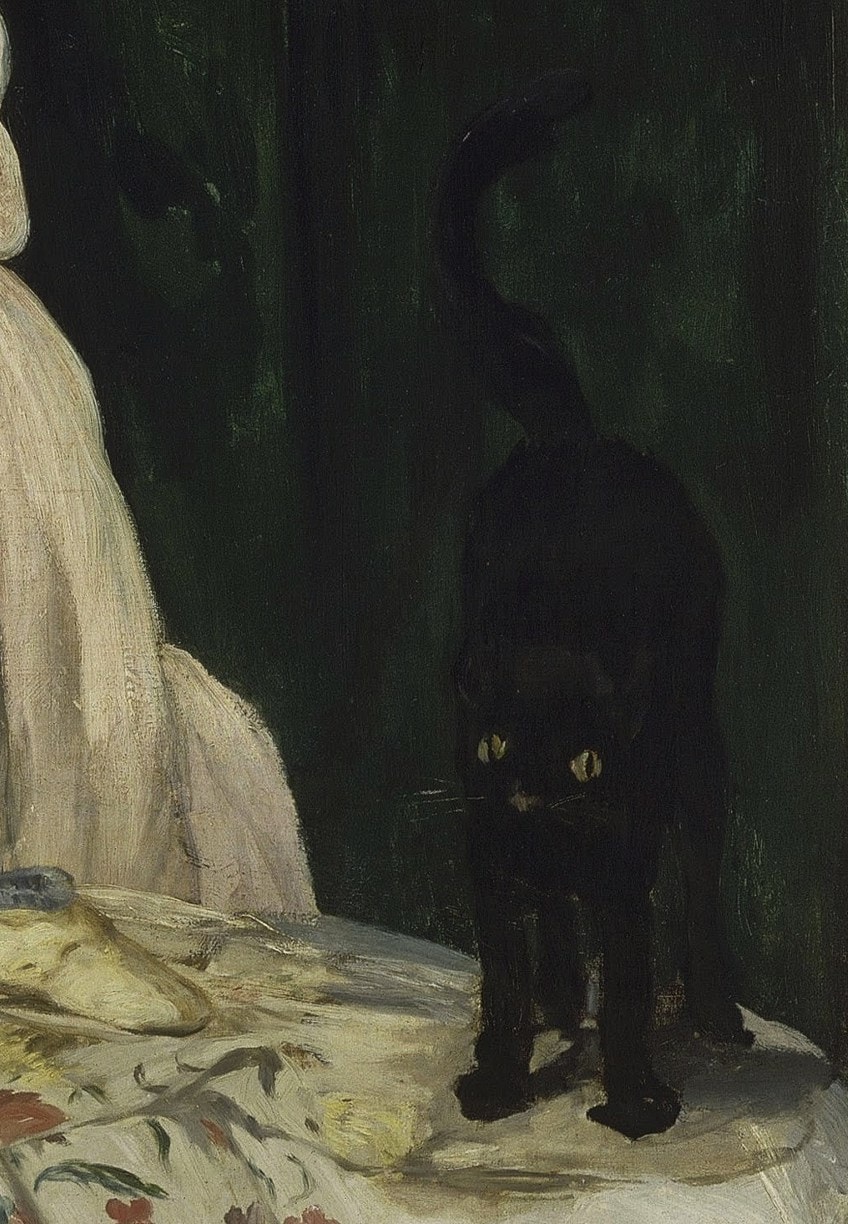 A detail of A detail from Olympia (1863) by Édouard Manet, showing the loose castor strokes used by the artist; Édouard Manet, Public domain, via Wikimedia Eatables
Perspective and Line
In that location is an evident horizontal and vertical play hither, for example, the horizontality of Olympia's figure and her chaise longue taking up the width of the limerick. What is notable is the golden vertical line on the wallpaper in the background, dividing the dark red role of the wall from the dark dark-green. This line is spaced only slightly away from Olympia'southward genital area where her hand rests.
The fact that Manet barely utilized linear perspective gives the painting a flatter appearance and brings the entire scene closer to us. This painting is often compared to Titian's "Venus of Urbino" (1534) painting.
We encounter how Titian created a background scene utilizing linear perspective and a vanishing point in the distance, which gives the scene a sense of depth. Furthermore, the vertical line from the curtain backside Venus directly lines up with her genital area, placing more focus on that area – as noted, this is slightly off-center in Manet'southward Olympia.
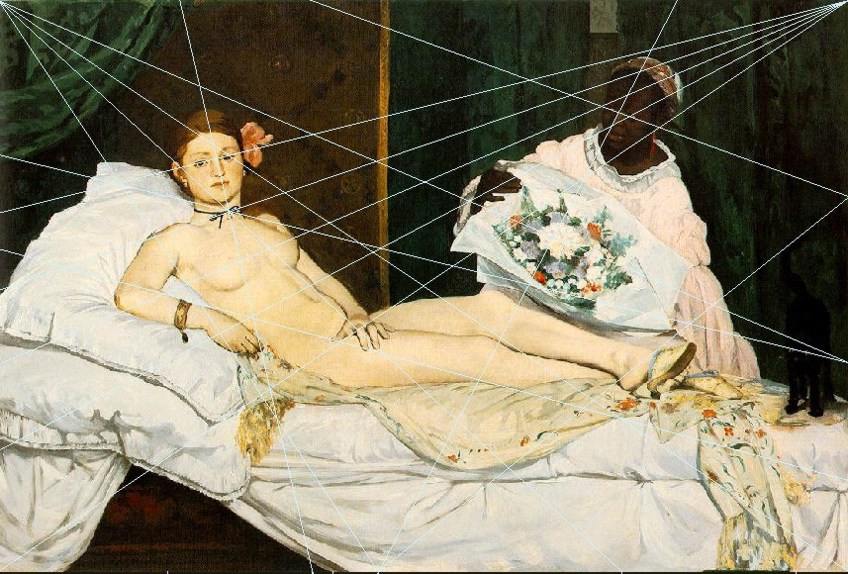 Perspective and line within Édouard Manet's Olympia (1863); User:Instance, Attribution, via Wikimedia Commons
Scale and Scandal
Manet's Olympia was painted on a large canvas, measuring 130.5 by 190 centimeters. This was apparently a large format for a Genre painting of the time, as we mentioned earlier about the bureaucracy of genres, History Paintings were normally done on large canvases considering of their importance.
This is worth noting equally nosotros put ourselves in the shoes of academicians in 19th century France: What would they have thought when they viewed such a large, scandalized delineation of what should accept been a voluptuous, and peradventure meeker, goddess?
Manet's Olympia: Symbolic References
In Manet'due south Olympia, the unabridged scene might be a symbolic reference, nevertheless, there are other elements worth highlighting. In Titian'due south Venus of Urbino (1534), we see a sleeping canis familiaris nearly the far-right foot of the chaise longue, this creates a completely different ambiance compared to Manet's black true cat, too situated in the far right of the chaise lounge.
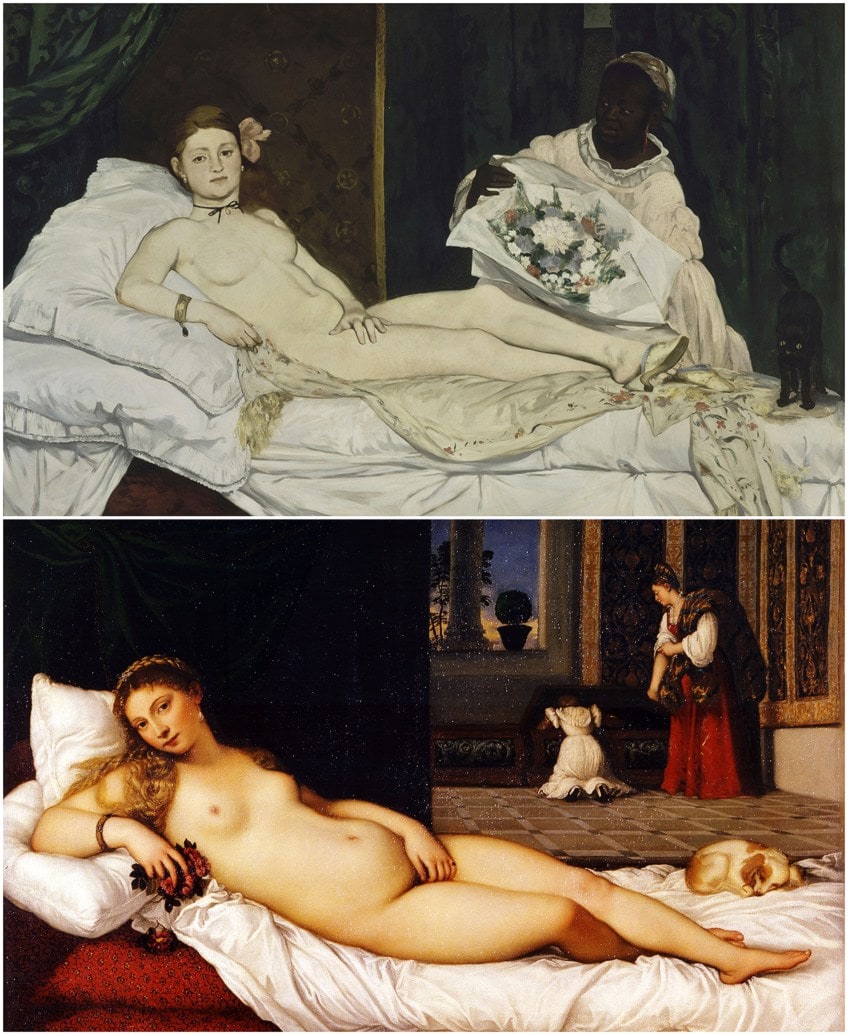 Tiptop: Olympia (1863) by Édouard Manet;Édouard Manet, Public domain, via Wikimedia Eatables | Lesser: Venus of Urbino (1538) past Titian; Titian, Public domain, via Wikimedia Commons
Reportedly, a black cat symbolized promiscuity and female courtesans. Dogs symbolized allegiance and love every bit we see in Venus of Urbino. Furthermore, dogs were commonly included in Renaissance paintings. This distinction creates further racket between Manet'south Olympia and the traditional painting styles.
Manet and Feminism: Olympia, the Maid, and the Matter of a Gaze
Perhaps Manet did not look that his Olympia would cause such an uproar even into the 20th and 21st centuries. It has become a widely debated painting within the Feminism move, specifically regarding the bailiwick of the male person gaze and the role of the maid.
Manet'south maid was a model named Laure who also modeled for him in his other painting titled "Children in the Tuileries Garden" (1862).
 Children in the Tuileries Gardens (c. 1861-1862) past Édouard Manet;Édouard Manet, Public domain, via Wikimedia Commons
Her role in Manet'south Olympia has been critiqued as being a "peripheral" negro and "robot" by the American author and artist Lorraine O'Grady. In O'Grady's essay Olympia'due south Maid: Reclaiming Blackness Female Subjectivity (1992) she explores how Manet's maid is depicted in a western manner and from a European perspective. The maid is seemingly overshadowed by the white woman reclining in front end of her.
Furthermore, O'Grady states that the maid is "made to disappear into the background drapery. While the confrontational gaze of Olympia is often referenced as the height of defiance toward patriarchy, the oppositional gaze of Olympia'due south maid is ignored: she is part of the background with piffling to no attention given to the disquisitional office of her presence".
Apart from the somewhat dubious role of Manet'southward maid, another notion touched on by this painting is the male person gaze.
As we mentioned in the above text this painting would have been viewed mostly by men, in the Salon, just it is equally fitting that the field of study matter suggests the female person is a prostitute who would accept been gazed at by men and been the object of their affections and desires.
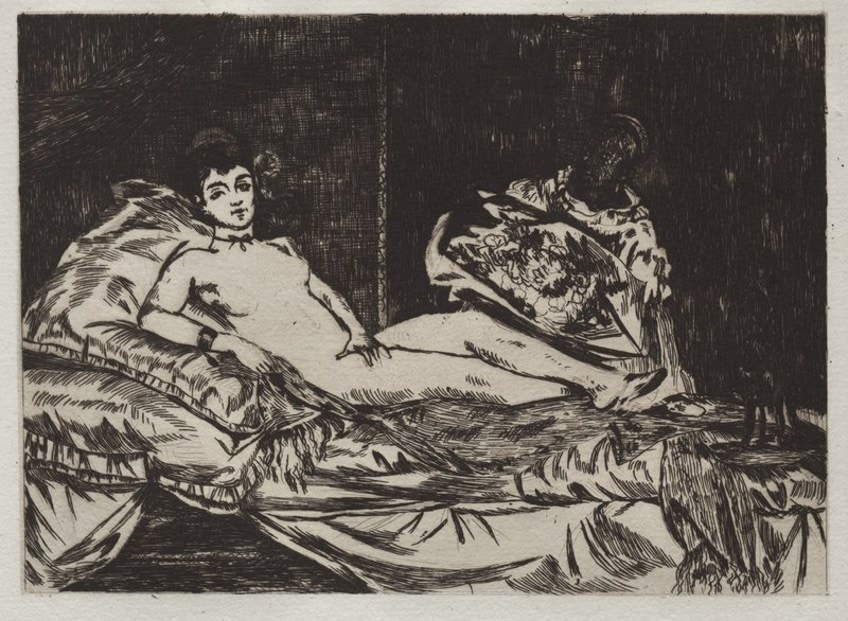 A preliminary version of Olympia by Édouard Manet;Cleveland Museum of Art, CC0, via Wikimedia Eatables
Manet: Causing a Scene
Manet certainly causes a scene with his modern subject matter placed within a traditional space filled with Classical expectations. This somehow did not stop him from winning a spot in the Salon's exhibition, fifty-fifty after so many ridiculed and criticized his painting; Manet is widely quoted as stating in a letter to Charles Baudelaire, "They are raining insults upon me!".
The author and art historian, Eunice Lipton, has often been quoted as stating nigh Manet's images, "robbed as they are of their mythic scaffolding, are assuming indeed". She farther explains that Manet's "women are seen as strong, autonomous beings, firmly proverb no to centuries of conventional beliefs" and that they are not "updated versions of Venus, Flora, Mary or Salome. Manet's women are only people".
Despite Manet disregarding "centuries of conventional behavior" he nonetheless "updated" the thought of how women were portrayed and placed inside art and society. Perchance he was regarded as mocking or disrespectful, maybe he was criticized, merely he certainly showed the conservative academicians in France what was happening in the real world, on the streets, where real people lived, far removed from the more than fantastical and mythical characters from the past.
Accept a expect at ourOlympiapast Manet webstory here!
Oftentimes Asked Questions
What Is That Famous Painting of a Woman Lying Down?
While there are hundreds of paintings of women lying downward, 1 of the more famous depictions, often criticized every bit scandalous, is the French Realist and Impressionist Édouard Manet's Olympia (1863). Information technology depicts a adult female reclining confidently on a chaise longue starting direct at the viewers. It is believed that Manet depicted this adult female equally a French prostitute. While she stares at the viewer she is presented with a bouquet of flowers by her maidservant.
What Was the Artist of Olympia Trying to Practise?
In Olympia Manet depicts a controversial scene of a reclining prostitute in a pose reminiscent of how goddesses were portrayed in academic paintings from the 19th century. This sparked controversy because Manet highlighted modern life versus the mythological or Biblical scenes that were acceptable according to the fine art academics of the time. Manet also painted in an expressive manner, which veered away from the stylistic rules of painting that were in line with Classical Antiquity. In Olympia Manet questioned the traditionalism that was so rooted in fine art and he paved the way for modernism.
Who Was Manet's Olympia?
The woman in Édouard Manet's Olympia was a French model, her name was Victorine Meurent; she was also an artist who exhibited at the Salon several times. Meurent too modeled in other paintings past Manet, for example, The Street Vocalizer (1862), Le Déjeuner sur l'Herbe (1862 to 1863), Lady with a Parakeet (1866), and The Railway (1873) among others. She also modeled for other artists like the Belgian Realist Alfred Stevens and his painting The Parisian Sphinx (c. 1875 to 1880).
guzmancomillonall.blogspot.com
Source: https://artincontext.org/olympia-manet/
0 Response to "Manet S Olympia Is a Reference to What in Previous Art?"
Enregistrer un commentaire